Wrist Movement and Body Positioning
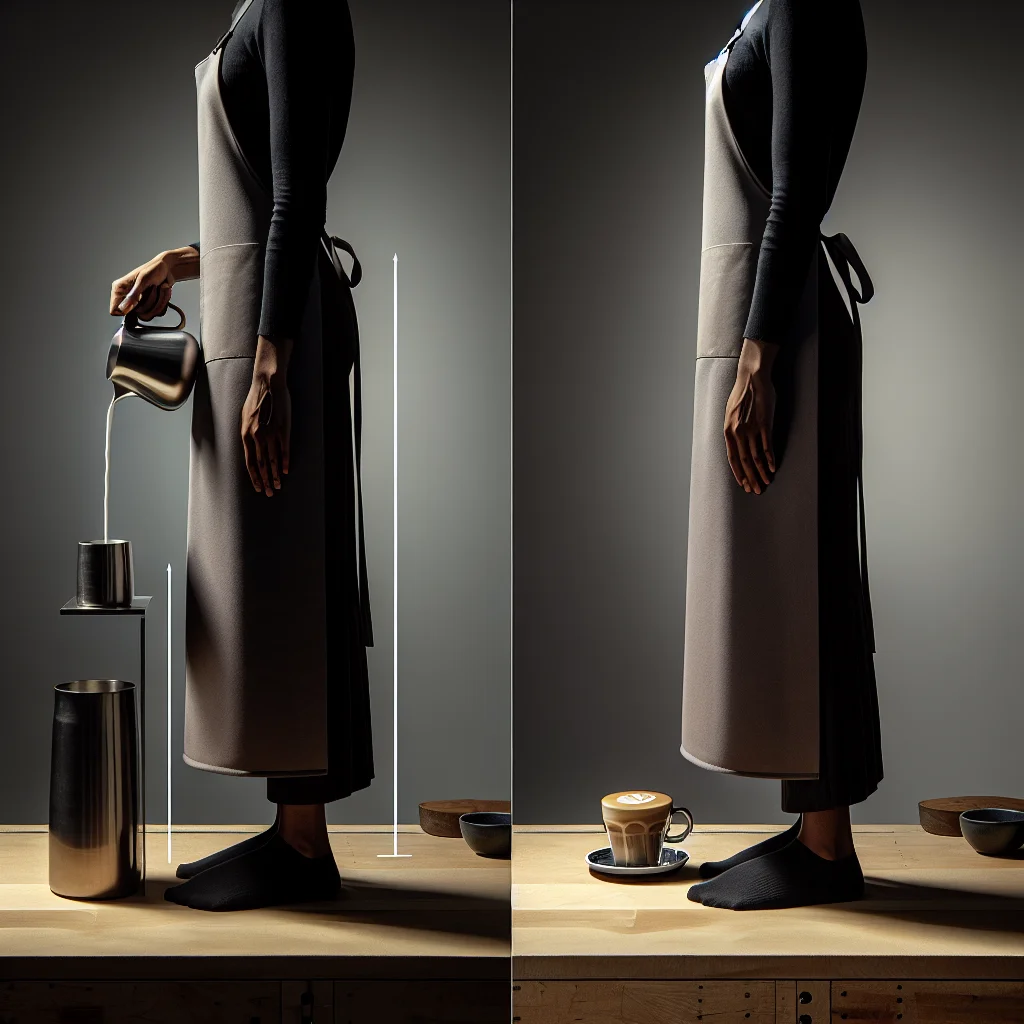
Most pouring problems that look like flow-rate issues or milk-texture failures are actually postural ones. Your body is the frame that holds the pour steady; your wrist is the fine-adjustment dial. Get the frame crooked and no amount of dial-twiddling rescues the pattern. What follows is a breakdown of how the whole kinetic chain — feet through fingertips — contributes to what ends up in the cup.
Stance and Torso Position
Stand with your feet roughly shoulder-width apart, weight distributed evenly or shifted very slightly toward your front foot. The cup should sit on a stable surface directly in front of your sternum — not off to one side, not at arm’s length. If you find yourself reaching, move closer. Reaching introduces a shoulder shrug that ripples all the way down to the spout.
Keep your torso quiet. A common intermediate habit is leaning forward as the cup fills, as though peering into it will improve the pour. It won’t. That forward drift changes the distance between spout and crema incrementally, which is exactly the variable you’re trying to hold constant during the base layer. Lock your torso angle early and let the arms do the remaining work.
Elbow and Forearm: The Stability Layer
Your pouring arm’s elbow should rest lightly against or just off your ribcage. This isn’t a rigid clamp — think of it as a soft anchor. When the elbow drifts away from the body, the forearm becomes a longer lever, amplifying every small tremor into visible wobble at the spout. Tuck it in, and the pour smooths out almost immediately.
The forearm controls two things: height (raising and lowering the spout relative to the crema) and tilt (the angle of the pitcher, which governs flow rate). These two adjustments happen simultaneously during every pour, so the forearm needs to move freely while the elbow stays relatively parked. Practice tilting the pitcher slowly through its full range with your elbow anchored — even with just water — until the motion feels independent of your shoulder. Refer to Pouring Fundamentals for the specific height and angle ranges you’re targeting.
Wrist Movement: The Precision Layer
From here, the wrist handles the detail work — the wiggle, the directional shifts, the strike-through. A useful mental model: the forearm decides where and how much milk flows; the wrist decides what shape that milk takes.
For patterns like the rosetta, the wiggle originates almost entirely from side-to-side wrist rotation. The pivot point sits near the base of the palm, not at the fingertips. If you watch your knuckles while wiggling, they should trace a short, even arc — no more than two or three centimetres at the spout tip. Bigger arcs look dramatic but produce wide, blurry leaves.
A few specifics worth internalising:
- Keep the grip relaxed. A death-grip on the pitcher handle transmits hand tension straight into the pour. Hold the pitcher firmly enough that it won’t slip, and no firmer.
- Pivot, don’t swipe. Side-to-side wrist motion should rotate around the forearm’s axis. Lateral swiping (moving the whole hand left and right) creates uneven spacing in symmetrical patterns.
- Use the non-pouring hand deliberately. The hand holding the cup isn’t just a cup holder — tilting the cup toward you during the base pour, then levelling it as the design phase begins, is a whole separate skill. That cup-hand tilt is covered in detail on the heart pour page.
Putting It All Together
The chain runs from the ground up: stable feet, quiet torso, anchored elbow, free forearm, precise wrist. Each layer absorbs the coarser movement so the next layer only has to manage finer adjustments. Yes, it feels mechanical and overthought at first. After a few dozen repetitions it compresses into a single fluid gesture — which is the whole point of drilling it as separate layers now.
If your patterns are inconsistent and you’ve already worked through common mistakes, revisit your stance and elbow position before blaming your milk texture. More often than not, the fix is postural, not textural. For the specific angle and flow-rate numbers that pair with this body positioning framework, head over to Pouring Fundamentals.