Pouring Fundamentals: Angle, Height, and Flow Rate
Every latte art pattern — from a simple heart to a layered tulip — is assembled from the same three physical variables: the angle of the cup, the height of the pour, and the rate at which milk leaves the pitcher. Change one and the others must compensate. Understanding how they interact is less about memorising numbers and more about developing a feel for the relationship between them. From here, everything else on this site will make more sense.
Angle: Tilting the Cup and the Pitcher
Tilt the cup toward you at roughly 30 degrees from vertical before you begin pouring. This does two things: it brings the surface of the espresso closer to the spout of the pitcher, and it creates a deeper pool on the far side of the cup where the milk can sink beneath the crema during the initial fill.
Your pitcher angle mirrors this. At the start of the pour, the pitcher’s spout sits relatively upright — maybe 15 to 20 degrees — releasing a thin, controlled stream. As the cup fills and you begin to level it, the pitcher tilts further forward to increase flow and reduce the distance between spout and liquid surface.
The key sensation to notice: as the cup approaches level (roughly two-thirds full), the surface of the drink rises toward you. This is the transition point where white art begins to appear on the surface. If you level the cup too early, milk sinks before you’re ready to lay down a pattern. Too late, and you run out of room.
Height: The Distance Between Spout and Surface
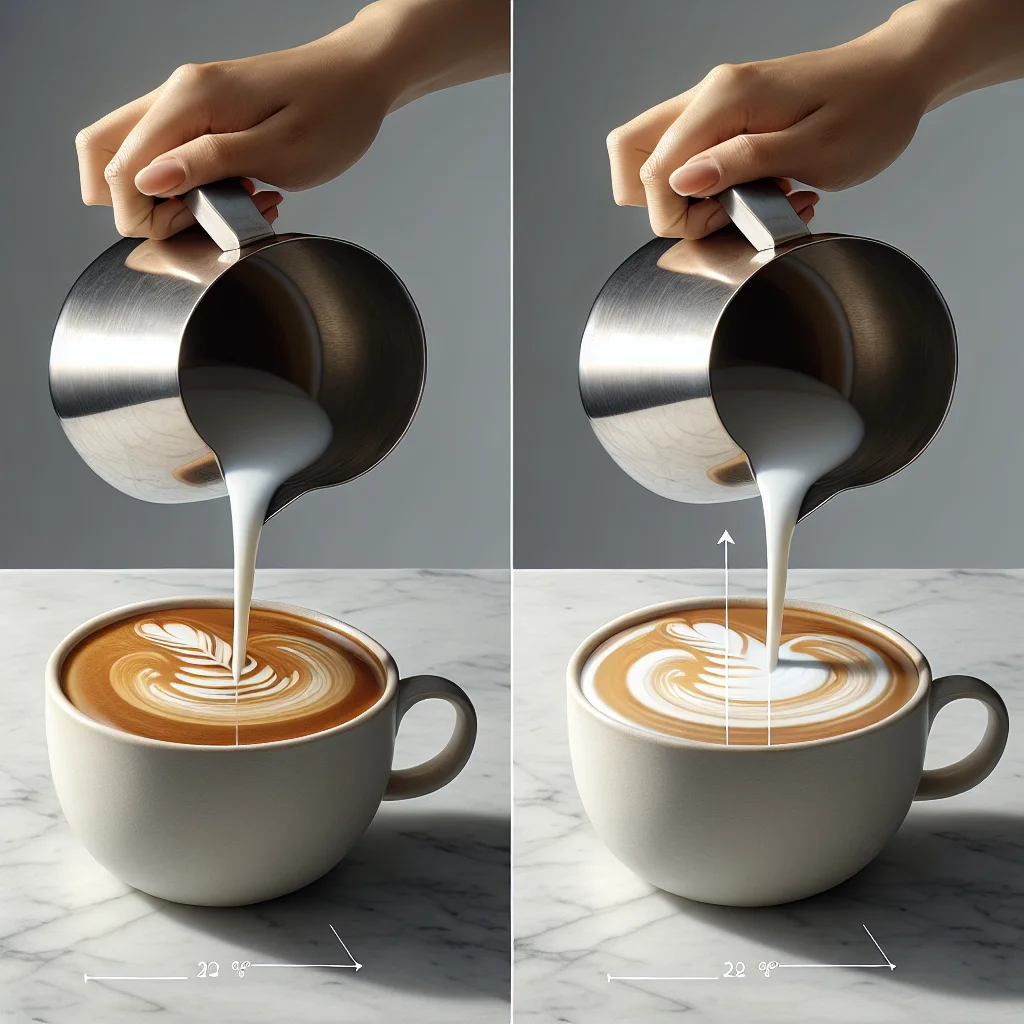
Height is really a proxy for velocity. Milk poured from higher up hits the surface with more force and dives beneath the crema. Milk poured from close range lands gently and sits on top — which is exactly what creates visible contrast.
During the base pour (the first roughly 60% of the cup), maintain about 3–5 cm between the spout and the liquid surface. This keeps the stream narrow and drives milk below the crema, building volume without disturbing the canvas. As you transition into the art phase, bring the spout down until it nearly touches the surface — sometimes within a few millimetres. At this point, the milk has almost no downward momentum and fans out across the top.
A common instinct is to raise the pitcher to “aim” more precisely. Resist it. Raising the spout mid-pattern punches milk through the surface and disrupts whatever you’ve started. If you need to reposition, slide the pitcher laterally rather than lifting it. (Yes, you will fight this instinct for longer than you’d expect.)
Flow Rate: Controlling the Stream
Flow rate is governed by how far you tilt the pitcher forward and, to a lesser degree, by how much milk remains inside. A fuller pitcher is heavier and wants to tip faster — something worth noting at the start of a pour when the pitcher is at its heaviest.
During the base pour, you want a thin, steady stream — roughly pencil-width. This is enough to fill the cup at a reasonable pace without disturbing the crema. As you move into the design phase, open the flow by tilting the pitcher more aggressively. The wider stream is what gives techniques like the wiggle their lateral spread.
The mistake that catches most intermediate pourers is inconsistent flow during the pattern phase. A hesitant, stuttering stream creates broken lines and uneven lobes. Commit to a smooth, continuous tilt once the art begins. Adjustments happen through wrist speed and lateral movement, not by throttling the stream on and off.
How the Three Variables Work Together
Think of angle, height, and flow rate as a single coordinated gesture rather than three separate dials. As the cup levels, the spout drops and the flow opens — all in one continuous motion. Practising this transition until it feels like one movement, not three sequential decisions, is where consistency starts to live.
For a deeper look at how your wrist and body support this coordination, see the wrist and body mechanics guide. If you’re already comfortable with these fundamentals and want to start applying them to specific designs, the pattern catalog breaks down each pour with annotated diagrams. And if something keeps going wrong — milk sinking when it should float, patterns drifting off-centre — the common mistakes guide maps symptoms to specific variables worth adjusting.