Frequently Asked Questions
Most of the questions that arrive about pouring fall into a handful of recurring themes: pitcher mechanics, milk behaviour in the cup, and why a pattern that worked yesterday has vanished today. The answers below address the most common sticking points, roughly in the order they tend to surface as your pouring develops.
Pitcher and Cup Basics
Does pitcher size matter for latte art?
It does, though not in the dramatic way you might expect. A pitcher that’s too large for the drink volume forces you to tilt at extreme angles just to reach the milk surface, which makes flow rate harder to control. A pitcher that’s too small leaves no room for a proper vortex during steaming. For a standard 150–180 ml espresso-based drink, a 350 ml (12 oz) pitcher gives you enough working volume while keeping the spout close to the crema. For larger drinks, move to a 600 ml (20 oz) pitcher. The relationship between volume, tilt, and pour height is covered in more detail on the pouring fundamentals page.
Does the cup shape change anything?
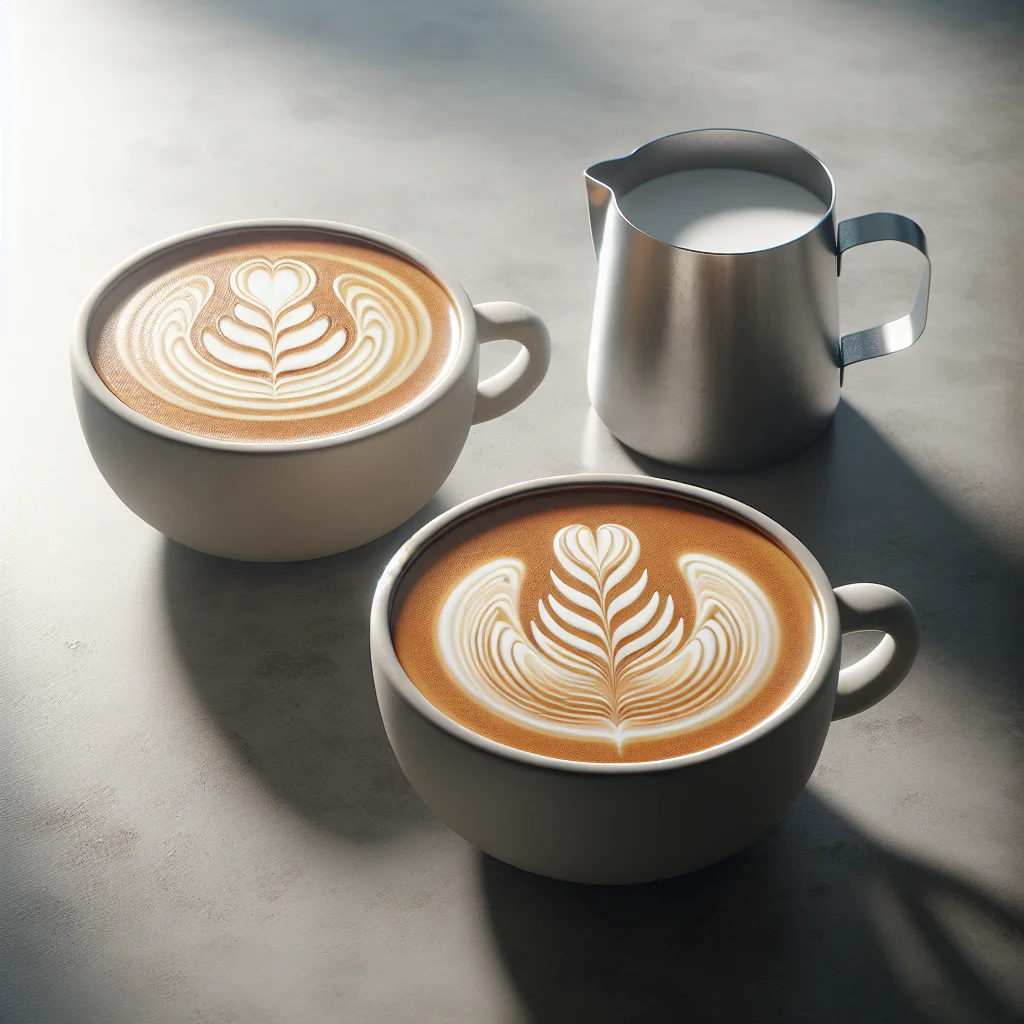
Quite a lot, actually. A wide, shallow bowl gives you a larger canvas but thins the crema layer faster, meaning your timing window shortens. A taller, narrower cup holds crema depth longer but compresses the design. Round-bottomed cups are generally more forgiving because the milk circulates more evenly as you pour. If you’re practising a specific pattern, try to use the same cup each session — one less variable moving beneath your hands.
Milk Texture and Temperature
My milk looks good in the pitcher but falls apart in the cup. What’s happening?
Nine times out of ten, the texture is slightly too airy — just enough that it feels smooth during steaming but separates into visible foam and thin liquid within seconds of stopping. The test is simple: after steaming, tap the pitcher base once on the counter, then swirl for three to four seconds. If the surface doesn’t settle into a uniform, paint-like sheen, the milk needs more integration time during steaming (longer rolling, fewer bursts of air). Texture diagnosis overlaps heavily with the fixes described on the common mistakes page.
How hot should the milk be?
Aim for the point where the side of the pitcher becomes uncomfortable to hold but not impossible — roughly 55–65 °C (131–149 °F). Beyond that range, proteins begin to break down, the sweetness drops, and the micro-foam destabilises. You lose the body that lets white ink sit on brown canvas.
Building Consistency
I can pour a decent heart sometimes. How do I make it reliable?
Consistency is a sequencing problem, not a talent problem. The most effective approach is to isolate one variable per session. Spend an entire session focused only on your starting height before the pattern begins, keeping everything else as automatic as possible. Next session, focus only on the moment you drop the spout toward the surface. The heart pour page breaks this into discrete phases with annotated diagrams for exactly this kind of targeted practice.
How long does it take to get consistent?
Longer than social media suggests and shorter than frustration makes it feel. Most people pouring daily can produce a recognisable heart within a week or two and a passable rosetta within a month or two. Yes, you will pour approximately forty terrible swans before a passable one appears. The variable that accelerates progress most isn’t raw repetition — it’s filming your pours from a consistent angle and reviewing the pitcher path afterward. A phone propped against a canister at counter height is sufficient.
Does body position really affect the pour?
More than most people expect. A locked elbow routes all movement through the shoulder, which is too coarse for the small oscillations a tulip or rosetta requires. The wrist and body mechanics page walks through stance, elbow angle, and wrist pivot in detail — it’s worth reading even if your patterns are already forming, because small postural adjustments tend to unlock the next level of control.
If your question wasn’t covered here, browsing the pattern catalog or the pouring fundamentals guide will likely address it in context. Most pouring problems, once you slow them down, turn out to be one of about six mechanical habits hiding in plain sight.